Seven PDP Governors Shift to APC and ADC Chances Ahead of 2027
Since President Bola Tinubu took office in May 2023, Nigeria’s political map has been redrawn by a steady migration of power from the opposition to the ruling party.
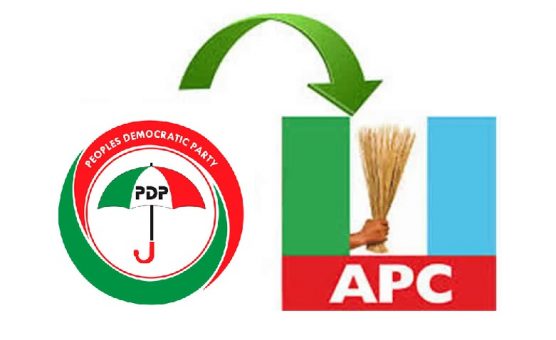
Seven governors originally elected under the Peoples Democratic Party (PDP) have crossed over to the All Progressives Congress (APC), a strategic exodus that has crippled the main opposition party while reshaping the landscape for the 2027 general elections.

This realignment has not only consolidated the APC’s dominance but has also opened a critical, though narrow, window of opportunity for smaller parties like the African Democratic Congress (ADC) in a political system long defined by a two-party duopoly.
The defection of these seven governors represents a direct assault on the PDP’s structural and geographic strongholds.
The blow has been most devastating in the South-South, once an impenetrable PDP fortress. Here, four governors, Siminalayi Fubara of Rivers, Sheriff Oborevwori of Delta, Umo Eno of Akwa Ibom, and Douye Diri of Bayelsa, abandoned the party.
Their departures, framed as tactical survival, strategic realignment, or a response to the party’s “terminal decline,” have stripped the PDP of its core regional base.
The shift extended to the South-East with Peter Mbah of Enugu and to the North-Central with Caleb Mutfwang of Plateau and Agbu Kefas of Taraba, each citing the imperative of federal alignment for development and security.
The motivations are rooted in the hard calculus of Nigerian politics: access to the federal centre, with its control over resources, security, and patronage, is paramount for any governor seeking projects and political security.
This pragmatism is amplified by the PDP’s profound internal crisis, a party marred by factionalism and weak leadership, which has rendered it a liability rather than an asset for its elected officials. With the 2027 elections approaching, these defections are pre-emptive moves to position within the party perceived as most likely to retain national power.
The implications for Nigerian democracy are stark. The opposition has been gutted at the gubernatorial level, losing financial muscle, territorial influence, and strategic depth.
This erosion raises the spectre of a de facto one-party-dominant system, threatening to reduce governmental accountability, limit genuine policy alternatives, and deepen public cynicism.
The PDP’s diminished capacity to mount a credible nationwide challenge suggests the 2027 presidential election could be a foregone conclusion in vast swathes of the country.
Yet, this consolidation of the APC and the collapse of the PDP has inadvertently created a precarious opening for a third force. The African Democratic Congress (ADC) now operates in a political climate ripe with voter disillusionment toward the two dominant parties.
A palpable appetite for alternatives, particularly among the youth and urban electorate, could translate into protest votes.
The fluid landscape also allows for strategic alliances; should the ADC position itself as the nucleus of a coalition with other minor parties or attract high-profile defectors, it could rapidly gain credibility and resources.
However, the ADC’s path is obstructed by formidable hurdles. The party faces a profound financial and logistical disadvantage compared to the well-resourced APC and PDP, restricting its capacity for nationwide mobilization.
Its relatively underdeveloped national structure and lack of deep-rooted brand recognition, especially in decisive rural areas, compound this challenge. Most critically, the ADC must contend with the “wasted vote” syndrome, where voters strategically gravitate to one of the two perceived front-runners, fearing a vote for a smaller party is a vote lost.
Therefore, a successful outing for the ADC in 2027 will not be measured by a presidential victory but by strategic, targeted gains. Its most plausible path lies in securing a handful of governorship seats in states with favourable local dynamics, significantly increasing its representation in the National and State Assemblies, and potentially emerging as a decisive “kingmaker” in a finely balanced legislature.
While the presidential contest will almost certainly remain a duel between the APC and a weakened PDP, the ADC’s performance will serve as the true barometer for the viability of alternative politics in Nigeria.
The great defection of 2027 has not only rewritten the rules of the game but has also set the stage for a critical test of whether Nigeria’s political space can finally expand beyond its entrenched and fading duopoly.
- Doris Ogala Slaps Pastor Chris Okafor With ₦1B Lawsuit Over Broken Marriage Vow
- Davido Picks Asake, Rema, Omah Lay as Nigeria’s Next Music ‘GOATs’
- Doctor Gets Life Imprisonment for Poisoning 30 Patients, Killing 12

Share your story or advertise with us: Whatsapp: +2348033202396 Email: sentinelnewsng@gmail.com